
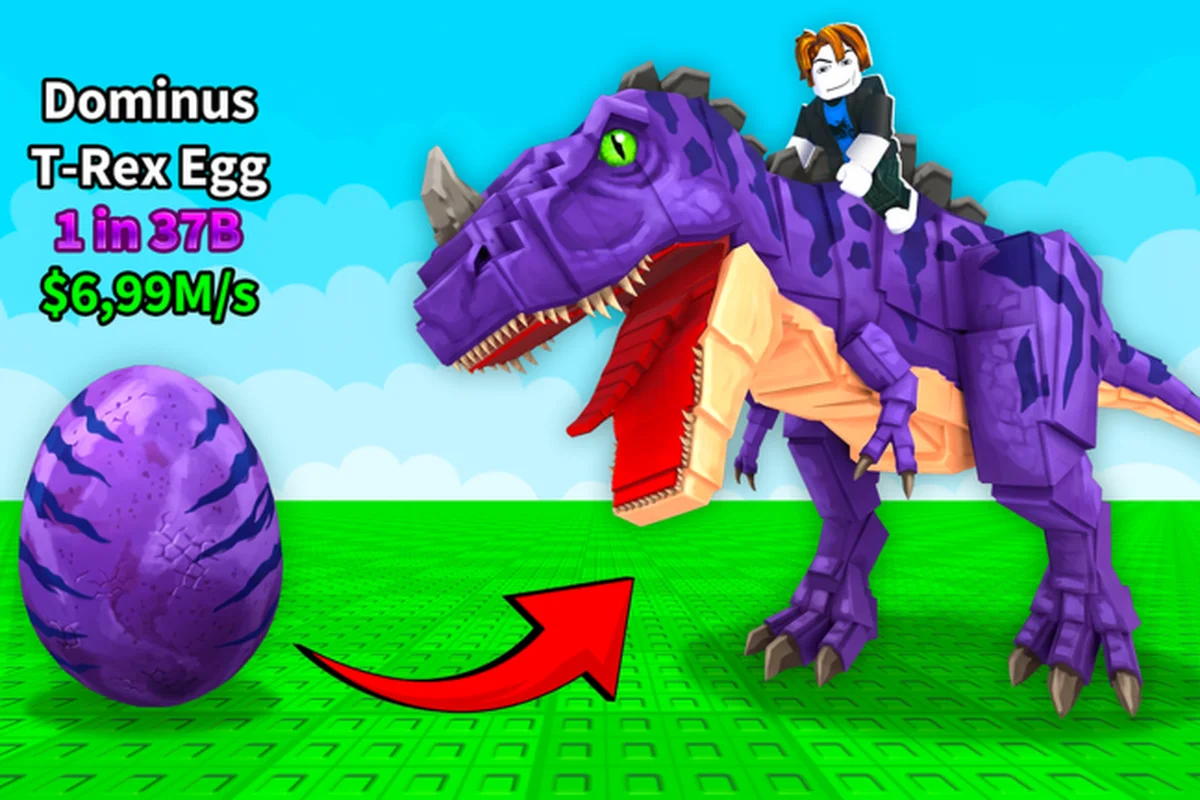
A new dino rider's first hour decides whether they stall out chasing eggs they can already reach or unlock the speed loop that fuels real progress. This Ride a Dino beginner guide breaks down the exact loop the developers describe on the official Ride a Dino Roblox page — explore, hatch, ride, mutate, collect — and translates it into the kind of small, repeatable decisions that turn a blank spawn into a growing roster within a single session.
The game launched on 2026-09-18 and was last updated on 2026-10-12. As of the 2026-10-18 snapshot, it has roughly 2.57 million visits, around 27.9K favorites, and an 87.7% like ratio. Servers cap at six players, which means competition for eggs is real but manageable. Everything below is built around the mechanic loop the developer actually publishes, not fan-made species lists floating around YouTube thumbnails that mostly cover a different, similarly-named experience.
Understanding the Ride a Dino Core Loop
Every useful action in Ride a Dino is part of one closed loop: discover a hidden egg, hatch a dinosaur, ride it to reach harder-to-find eggs, mutate to push speed higher, and collect rare dinos. The official description on the Roblox page is only four lines long, but those four lines describe the entire game — there is no quest log, no cash shop, no ranching pen to manage, and no gear to upgrade outside your dinosaur's own stats.
The loop rewards route efficiency over everything else. A player who runs in a straight line wastes time because eggs are scattered and the map is wide open, while a player who chains pickups from one end of the map to the other multiplies the number of hatches per session. Because servers only seat six riders, whoever is faster on the ground controls which eggs get claimed, and the gap widens with every successful mutation.
What the Game Has and Has Not Published
Ride a Dino is unusually sparse for a Roblox tycoon. The developer has not published a dinosaur species list, has not named any rarity tier, has not named any mutation, and has not released a single numeric value (no speed number, no hatch odds, no drop rate, no price). The only documented monetization is one game pass called Infinite Radar (Dino Riders! group page), described officially as "a radar you can use forever that always finds the nearest egg." There are no badges, no developer products, and no redeem-code system.
This guide uses a method-based framing on purpose: it judges a dinosaur on the three axes the developer names — speed, rarity, mutation payoff — without inventing names that the game has not given us. If a community source ever cites a specific "T-Rex with 999 MPH" or a "Divine tier," that information comes from a different game, not from this one.
The First-Hour Decision Framework
| Phase | Time Budget | Primary Goal | Key Output |
|---|---|---|---|
| Drop-in | 0–3 min | Learn controls, scout a small radius | First egg spotted |
| First hatch | 3–8 min | Hatch the egg and equip the mount | Riding a dinosaur |
| Speed upgrade | 8–25 min | Hunt harder-to-find eggs, mutate once | Higher rarity or better speed |
| Collection push | 25–60 min | Optimize routes, chase rare spawns | Two or three dinosaurs in roster |
The framework assumes a player who wants to make a real session count. The numbers are guidance, not a speedrun — players who take longer on the first hatch are not failing, but they are burning the time window where the map is still empty.
How to Hatch Your First Egg and Start Riding
The first mechanical hurdle is also the most forgiving: an egg will appear near your spawn within a short walk. The official description does not name egg locations or call out a specific egg type for beginners, so the right approach is to sweep a wide circle around your drop point and look for the egg's distinctive silhouette. Because eggs are hidden, the design intent is to reward players who actually move rather than spam-jump in place.
Steps to Your First Successful Hatch
-
Sprint in expanding circles for the first two minutes, because eggs tend to spawn at low-traffic coordinates and the fastest way to find one is distance, not digging.
-
Pick up the egg by walking over it — there is no key prompt published, so contact-based collection is the safest assumption.
-
Wait out the hatch timer, which the developer has not published numerically; community reports describe it as short enough to finish standing still.
-
Equip the dinosaur immediately by interacting with it once it appears in front of you, because an unhatched egg sitting on the ground is a free pickup for any of the other five players in the server.
-
Start riding before celebrating, because the speed of the new mount is what unlocks the next tier of eggs; if the dino feels slow, the next egg should be the priority over exploring for fun.
This same five-step pattern repeats every time a player chases a rarer hatch. The difference between a beginner and an experienced rider is not the steps — it is the speed at which they cycle through them.
Mounting and Movement Basics
| Control | Action | Beginner Mistake |
|---|---|---|
| Walk up to dinosaur | Mounts automatically when in range | Trying to double-tap or use a key prompt that does not exist |
| Hold forward | Sustained riding, full speed | Dismounting every few seconds to "check the map" |
| Jump while mounted | Small hop, no speed loss | Bunny-hopping on flat ground, which loses time |
| Dismount | Step away from the dino | Dismounting in the middle of an egg chase |
| Re-mount | Walk back into the dino | Waiting for a cooldown that does not exist |
The game supports desktop, console, mobile, and tablet, but the input feel differs. Mobile players in particular benefit from a quick test ride in an empty patch of map before committing to a long egg run, because touch-stick steering is the single biggest adjustment new riders make.
Reading Speed, Rarity, and Mutation Without Numbers
Ride a Dino's three progression knobs are speed, rarity, and mutation. The developer has not published a number for any of them, so the right way to evaluate a dinosaur is to compare the qualitative feel of the mount, the visible rarity cue, and how often you can afford to run a mutation cycle on it. This is a method-based tier framework, not a list of named species.
How to Judge a Dinosaur on Three Axes
-
Speed (qualitative): Watch how quickly the dinosaur crosses two landmarks you can see at the same time — a rock, a tree line, a hilltop. A "faster" dinosaur is one that visibly outpaces the previous mount on flat ground, regardless of what number a fan site might have invented.
-
Rarity (qualitative): The developer uses the word rarity on the official page but does not publish tier names. Treat the rarity cue as a visual signal: rarer hatches tend to look more distinct, animate differently, or stand out against the environment. Two rare hatches from the same egg do not always look identical, so do not over-fit your collection around one silhouette.
-
Mutation payoff (qualitative): Mutation "boosts speed" per the official description. Evaluate it the same way — does the mutated dinosaur move visibly faster than its pre-mutation form? If yes, the mutation was worth the time spent. If you cannot tell, the cycle was probably not worth running on that specific dino.
Method-Based Dino Tier Framework
| Tier | Speed (qualitative) | Rarity (qualitative) | Mutation Payoff | When to Run a Mutation |
|---|---|---|---|---|
| Starter | Noticeable on foot | Lowest visible cue | Modest speed lift | Only if you have a replacement ready |
| Mid-loop | Outpaces earlier mounts | Distinct silhouette | Clear, repeatable boost | Worth running after a successful hatch |
| Endgame | Visibly faster than anything else in the server | Rarest cue you have seen | Largest lift you can remember | Save for the best dino in your roster |
The reason this framework works is that the official description promises exactly these three knobs. If the developer later publishes named tiers, this method-based framework still holds — the player just has better vocabulary to label what they already see.
Ride a Dino Tips and Tricks for the First Hour
The first hour is where most beginners either build momentum or burn it. The five tips below are tuned for the 2026 build of the game and assume the sparse-data environment the developer has published. None of them rely on species names, code lists, or numbers the developer has not given us.
1. Treat the Map as a Route, Not a Playground
| Route Mistake | Time Cost | Fix |
|---|---|---|
| Backtracking to a missed egg | 30–90 sec | Plan a loop that visits each landmark once |
| Stopping to watch other players | 15–60 sec | Keep moving; rerun the same loop later |
| Wandering into unreachable terrain | 20+ sec | Stick to flat stretches until you have a fast mount |
| Dismounting in open ground | 5–10 sec each time | Only dismount near cover or a known egg spawn |
The fastest riders treat the map like a bus route: predictable stops, predictable order, predictable timing. The map is small enough to lap in a few minutes on a mid-loop mount, and lap time is the metric that actually matters in a six-player server.
2. Mutate With Intention, Not on Schedule
A mutation cycle is a real cost — it takes time the player could have spent hunting the next egg. Run a mutation when the dino in your roster is already your best mount, and when you can afford to lose ten to twenty seconds of riding time. Running a mutation on a starter dino right after a hatch is almost always a waste because the speed lift is smaller than the time you could have spent finding a rarer egg instead.
3. Read the Server Before You Chase
With a six-player cap, the server is small enough to track. If a faster rider is already circling a known egg spawn, the time-efficient move is to take the other side of the map, not to race them to the same coordinate. The two-minute egg cycle means a missed pickup now becomes a free pickup sixty seconds later, but only if the faster rider has moved on.
4. Use Infinite Radar Only as a Late-Game Unlock
The Infinite Radar game pass is the only documented monetization in Ride a Dino, and it does exactly what its name implies — it always finds the nearest egg. For a player still learning the map, manually exploring is faster than the radar would be, because each lap also teaches spawn coordinates. The radar pays off once a player already knows the layout and wants to shave time off the egg-chase step of the loop.
5. Ignore Cross-Game Data
Because several Roblox experiences share the words "Ride a Dino" in their titles, fan-made tier lists, code lists, and species rosters are circulating for different games. Anything that names a specific dinosaur, a specific tier, a specific mutation, or a redeem code almost certainly does not apply to the experience at placeId 131652231424227. The information in this guide is sourced only from the official Roblox page and the Dino Riders! group page; everything else is treated as unverified.
Common Beginner Mistakes and How to Avoid Them
Beginner mistakes in Ride a Dino tend to cluster around the same three failure modes: spending too long on a single hatch, ignoring the speed loop, and treating mutation as a goal instead of a tool. The list below is built from the mechanic loop the developer actually publishes, and each mistake has a concrete fix a player can apply within the same session. Most of these slip-ups come from a single hatch, ignoring the speed loop, and treating mutation as a goal instead of a tool, and the same kind of tunnel vision shows up in any auto-runner where timing windows are tighter than they look, which is why our walkthrough of the Ride A Dino Tablet Guide breaks each stage down by jump, dodge, and egg cycle rather than by raw upgrade priority.
Top Five First-Session Mistakes
| Mistake | Symptom | Fix |
|---|---|---|
| Over-celebrating a hatch | Standing still after the egg pops | Mount and ride before the animation finishes |
| Ignoring the speed loop | Riding a slow dino to "familiarize" with the map | Hatch a faster dino as fast as possible |
| Mutating too early | Burning time on a starter dino | Wait until the dino is your best mount |
| Dismounting in open ground | Resetting speed every 30 seconds | Only dismount near cover |
| Trusting third-party tier lists | Picking a "best" dinosaur that does not exist here | Judge by speed, rarity, and mutation feel, not by name |
The fastest path from "I just spawned" to "I have a real roster" is to run the loop cleanly, mutate with intent, and ignore any data the developer has not published. The speed of the dino in your hands right now is more important than any name on a fan-made list.
Frequently Asked Questions
What is the fastest way to progress in the first hour of Ride a Dino?
Focus on the speed loop the developer describes — hatch, ride, mutate — and chain pickups in a clean route. A beginner who sweeps the map, mounts immediately after each hatch, and saves mutations for their best mount will outpace a player who wanders and mutates every new dinosaur, because each minute spent moving is one more egg in the rotation.
Should I buy the Infinite Radar game pass as a beginner?
No, not yet. The radar is a time-saver, not a teacher, and a player who buys it before learning the map will not be able to read the radar's hints efficiently. Pick it up once you already know the egg spawns and want to shave a few seconds off each lap.
How do I know if a mutation was worth it?
Judge the mutation by visible speed gain, not by a number the developer has not published. If the mutated dinosaur outpaces the pre-mutation form on flat ground, the cycle was worth the time. If you cannot tell the difference, the mutation was not worth running on that specific dino and you should save future cycles for a stronger mount.
Are there any redeem codes for Ride a Dino?
No. As of 2026-10-18 the developer has not published a code system, and the official Roblox page does not list one. Any site that claims to have working codes for this experience is either covering a different game or fabricating data — ignore those lists entirely.
How many players can be in a single server?
The server cap is six players, which the official Roblox page documents. The smaller server size is part of why the speed loop matters: a faster rider controls the egg spawns, and the gap widens every minute.